

The Mental Health Benefits of Traveling While Working

by

Is burnout really just a vacation away from being solved? I have always figured that taking a week off from work to travel meant coming back lighter, steadier, and ready to work again. In my experience, this true, but only temporarily. Lying on a beach or wandering a new city can feel restorative while it’s happening. Then the trip ends and I’m pulled straight back into deadlines and the pressure to act like I never left. Within a week or two, I would feel the same way I did before taking a vacation. The feeling of burnout would return and I would simply go with the motions rather than perform my best.

Research shows that travel can lift our mood and that time away from work is tied to better mental health, but turning that lift into something that lasts is far harder than booking a flight (Kawakubo & Oguchi, 2022; Kim, 2019). That doesn’t mean the time off is wasted. It means the benefit depends almost entirely on what kind of break it actually is, and on what we do with it once we’re there.

A 2022 study followed more than 500 people in Japan before, during, and after a winter vacation. People who traveled reported higher wellbeing than those who stayed home, which is the easy part to celebrate. However, their wellbeing peaked before and during the trip. Then it dipped right after, and sat at its lowest a full month later. What mattered most wasn’t necessarily the destination or the budget. It came down to whether people did something genuinely new and challenging, which is an experience the researchers called mastery (Kawakubo & Oguchi, 2022).

There’s also another version of travel that has nothing to do with vacations. During the pandemic, many of us stopped moving around almost entirely. We worked from the kitchen table, skipped the commute, and left the house far less than we used to. A 2023 study across six large U.S. cities found that more telecommuting, fewer trips, and less use of transit and ride-hailing, were all linked to higher levels of anxiety and depression. The researchers suspected the missing ingredient was outdoor activity, along with the social contact and sense of movement that tend to come with it (Yang et al., 2023).
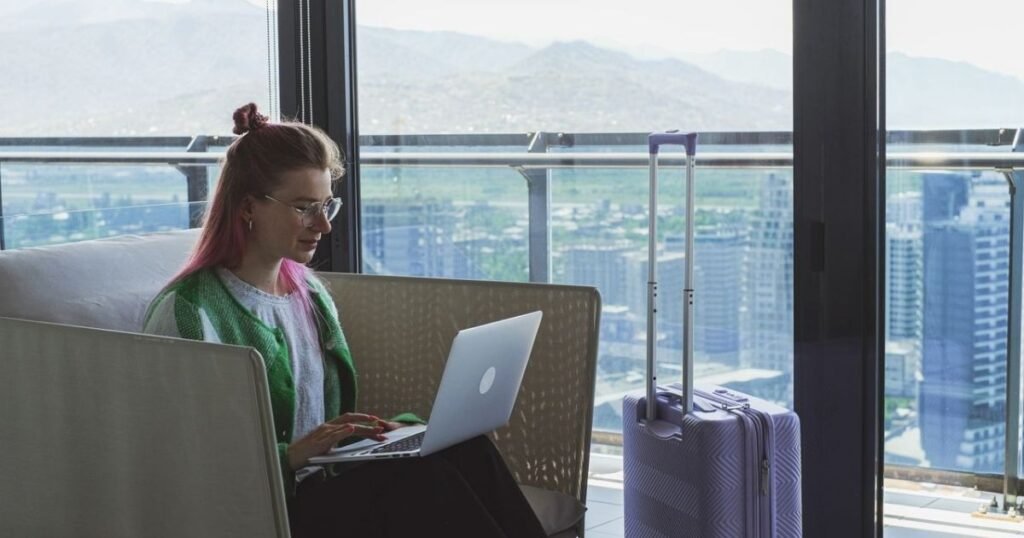
Work and travel can come in different tiers, including: 

  • Digital nomadism: Digital nomads are location-independent remote workers (e.g., freelancers, employees, and self-employed individuals) who use the internet to stay connected to their work while traveling domestically or abroad (Elliott, 2025).
  • Working holiday: A working holiday is an extended trip abroad during which travelers fund their journey by taking on short-term, seasonal jobs (e.g., waitstaff, farm work, or hospitality) while immersing themselves in local culture and making international connections (Bridge, 2016). 
  • Workcation: A workcation is a short-term arrangement in which remote workers perform their regular jobs from a leisure destination (Lufkin, 2022).
  • Bliesure: This form of business travel is the practice of extending a work trip by a few personal days to explore a destination before heading home and turning a company-funded journey into a partial vacation (Wong, 2024).

However, anyone considering any of these work-travel models should understand the requirements to avoid legal, financial, and professional complications. For digital nomads, overlooking visa conditions (e.g., proof of remote income, health insurance, and background checks) can result in denied entry or tax liability abroad (Elliott, 2025). Similarly, working holiday participants must meet strict eligibility criteria, including age limits and, in some cases, enrollment in a recognized sponsoring organization, without which participation may not be legally permitted (Bridge, 2016). 
So what actually helps? It’s doing something active, novel, or social, and being able to step away from work without losing pay or standing in the process. A challenging hike does more than a luxury suite. A real break does more than a long weekend spent half-answering emails. A policy that protects time off does more than a motivational poster about balance.

Until we treat rest as something to design well and actually guarantee, instead of something we squeeze in once a year, a vacation will keep feeling like a temporary exhale. A necessary one, even. Just not the cure we keep hoping it will be.

~ Dillon Price

Dillon Price is a native of Western Massachusetts. He has worked as a content writer for over eight years and is the owner and founder of EnRoute Jobs, a niche job board designed for digital nomads, travelers, and expats.

References

College Students: Tips To Improve Mental Health

With the school year in full swing, a lot is going on for students as they get acclimated again after summer break. Some are adjusting to a new schedule, or maybe a new school and all that entails, being in an unfamiliar place without familiar comforts if in college....

8 Ways to Protect Your Mental Health (When Living with a Mental Health Condition)

When I was a youth in the 80s and the 90s, mental health was never a priority. It wasn’t even a topic anyone I knew talked about. Most people, not within the mental health profession, hadn’t heard about bipolar disorder (previously called ‘manic depression’) or...

When Workplace Anti‑Stigma Trainings Don’t Stick

Is mental health at work really an awareness problem? If people just understood stigma better, I thought, they’d naturally become more supportive colleagues and managers. Unfortunately, that’s not always the case. Anti‑stigma workshops come and go in different...

The Epidemic of Loneliness – “Parasocial” Relationships

The Boston accent: Some call it grating, others call it iconic. While staring into your phone in bed, it comes clanging through the too-bright screen.  “Get ready with me IN KOREA!” Maybe, you’d call it enchanting. Or maybe that’s the addictive nature of social...

Using AI for Mental Health Advice: Tips for Parents

In life, there will be various stages or milestones one will encounter. Parenting is a lifelong commitment to help shape their child as they go through life. There will be great lessons learned navigating parenthood. One lesson to note is how to help children,...

is Algorithm speak “Un-aliving” The Conversation Around Suicide?

Before 2024, you likely did not hear the terms “unalive” or “unaliving” outside of online spaces, like TikTok. That is, until Seattle’s Museum of Pop Culture used it in their very-real Nirvana: Taking Punk to the Masses exhibit to describe the passing of Kurt Cobain....

How to turn Grief Into a More Helpful Experience

In life, people will encounter various experiences as they progress. One of these experiences includes experiencing the loss of a loved one. This experience is one everyone will experience at different points in their life, but it doesn’t make the grieving process any...

Can Paid Vacations help Alleviate Depression?

For many years, I treated the absence of rest as just part of being a working adult. It wasn’t the size of my to‑do list that finally made me question that belief, but the way my body and mind started reacting to life with no...

Can We Prevent Mental Illness?

We usually talk about mental health after someone is already struggling. After the panic attacks start. After the depression gets heavy. After things fall apart. But what if we asked the question earlier? Mental illness is common, and many conditions begin in the...

How Job-Related Stress Impacts Your Mental Health

For a long time, I treated work stress as just part of being an adult, meeting deadlines, dealing with difficult coworkers, and enduring long days. Many others around me seemed just as tired and overwhelmed, so I assumed that was simply the way things are supposed to...

The Weight of Winter

2.10.24 Birds must have flown south for the winter. Or wherever the *** it is birds go when thewind and the cold ransack the homes they had nested within the now barren branches. The trees look broken—almost. I didn’t even notice their orange and yellow leaves...

the Stigma of Mental Health still Fills the Halls of High School

When some think of high school, they may think of it as one of the happiest times of their lives. High school can be a period of personal growth where one develops self-identity, gains independence, makes lasting friendships, etc. This period in life can shape one’s...

My Synesthesia Causes Me to Hear Colors and Taste Sounds

We all know what our senses are and how we use them every day, but what if you could hear colors and taste sounds? This connection between senses is called Synesthesia, and some people have this complex condition inside their minds. Synesthesia is a mental condition...

The loss of someone you don’t know: How Matthew Perry’s death affected me

I was in elementary school when I first watched an episode of Friends. I was immediately drawn to the character of Chandler. We were both awkward. We were both funny. We both had problems. He was one of my first TV crushes after Shaggy from Scooby-Doo. I became...

Why I’m Involved: An Interview with Crystal Lancaster

I am volunteering at Breaking Taboo because I am extremely passionate about the cause of mental health and working towards ending the suicide epidemic currently facing this country. I myself live with Bipolar 1 Disorder. I had my first mental breakdown when I was 16...

How to Juggle Mental Health With Life: An Interview With Danni Blackman

I was born and raised in Orange County, still currently live in Tustin. Aside from taking care of my mental health at an outpatient facility, I work with my family as an administrative assistant at their law firm and I go to school for Gender Studies and Psychology. I...

Dr. Denise Nguyen Interview: Advice and Experience from a Marriage and Family Therapist

Meet Denise Nguyen.  I was born and raised in Southern California all of my life. I’m a 2nd generation Vietnamese American. My undergrad was through UCI and then received my Masters and Doctorate through Argosy University in Counseling Psychology (MA and EDDCP...

Caitlin Cawley Interview: Staying Strong Against Co-Morbid Mental Illnesses

We had the great pleasure of speaking with Caitlin Cawley. She is someone who shows resilience and fight against many things affecting her mental health. She continues to how one can overcome co-morbid mental illnesses, such as OCD, anorexia nervosa, PTSD, depression...

Surviving Trauma, An Interview with Katie Han

Meet Katie Han, a strong woman who is overcoming her incredible traumas every day. She suffered through childhood abuse and sexual harassment which led to her mood disorders. She shares her insights of how she has learned to love herself, heal, and cope with her...

Amy Chase’s Story of Surviving Abuse and Depression

We enjoyed being able to talk with Amy Chase. She shares her story of emotional and physical abuse, and depression. She has been through a lot since childhood, and is living proof that you can find yourself and heal from your traumas (even at 34 years old.) I wish...

Insights on Anorexia Nervosa & Anxiety by Sierralyn Cadima

We had the pleasure of talking with Sierralyn Cadima, who struggles with generalized anxiety disorder and Anorexia Nervosa. Here, she talks about the steps she has taken to overcome both and her outlook on mental health. Early 2014 when I started seeing a therapist...

How Carla-Rose Overcomes Her Depression & Anxiety

Meet Carla-Rose Smith, a prime example of someone who has been at their lowest of lows and was still able to crawl out of the misery and gain happiness within herself again. Here, she shares her insights about her personal struggle with anxiety and depression, and...

TV’s Dr. Judy Ho on Modern Mental Health

We had the pleasure of chatting with clinical and forensic psychologist Dr. Judy Ho, Ph.D about her career and her thoughts on modern mental health. Dr. Judy is the co-Host of Face the Truth on CBS and Tenured Associate Professor at Pepperdine University. She has a...